

Generating intelligence
An asset gets analysed one of two ways:
On-demand generation works regardless of whether the org-wide toggle is on, so you can always analyse a specific asset you need REX to know about right now.
What gets extracted
The result is a structured profile of the asset, not free text:- Overview: purpose, description, asset type, the product it’s about, category, region, industries, and segments it applies to, plus a freshness score.
- Personas: who it speaks to (role, seniority), their pain points, and how well the asset fits them.
- Sales stages: which stage or stages of the sales cycle it’s suited for, only flagged when the content clearly supports it.
- Features & integrations: capabilities and third-party tools it showcases.
- Competitors: who it positions against.
- Solutions: the business outcomes or value pillars it argues for.
Freshness score
Freshness isn’t an AI judgment. It’s calculated directly from the asset’s last-updated date, with full marks for anything updated in the last 3 months tapering to zero past 3 years old. It’s shown as a score, an age label (“3 mo ago”), and a status: fresh, stale, or outdated.How search is built on top of this
When you or REX search the library by meaning rather than by filename or folder, that search runs over the content of the intelligence graph, meaning the personas, features, and use cases that were extracted, rather than a raw keyword match against the file itself. That’s what makes a query like “find a case study for a fintech buyer” work even if the word “fintech” never literally appears in the file.How REX Chat uses it
REX Chat can search your library by keyword, by meaning, by type, by tag, by folder, by who uploaded it or when. It pulls the structured intelligence for a specific asset when it needs the detail (who it’s for, what stage it fits, how fresh it is) before recommending or attaching it.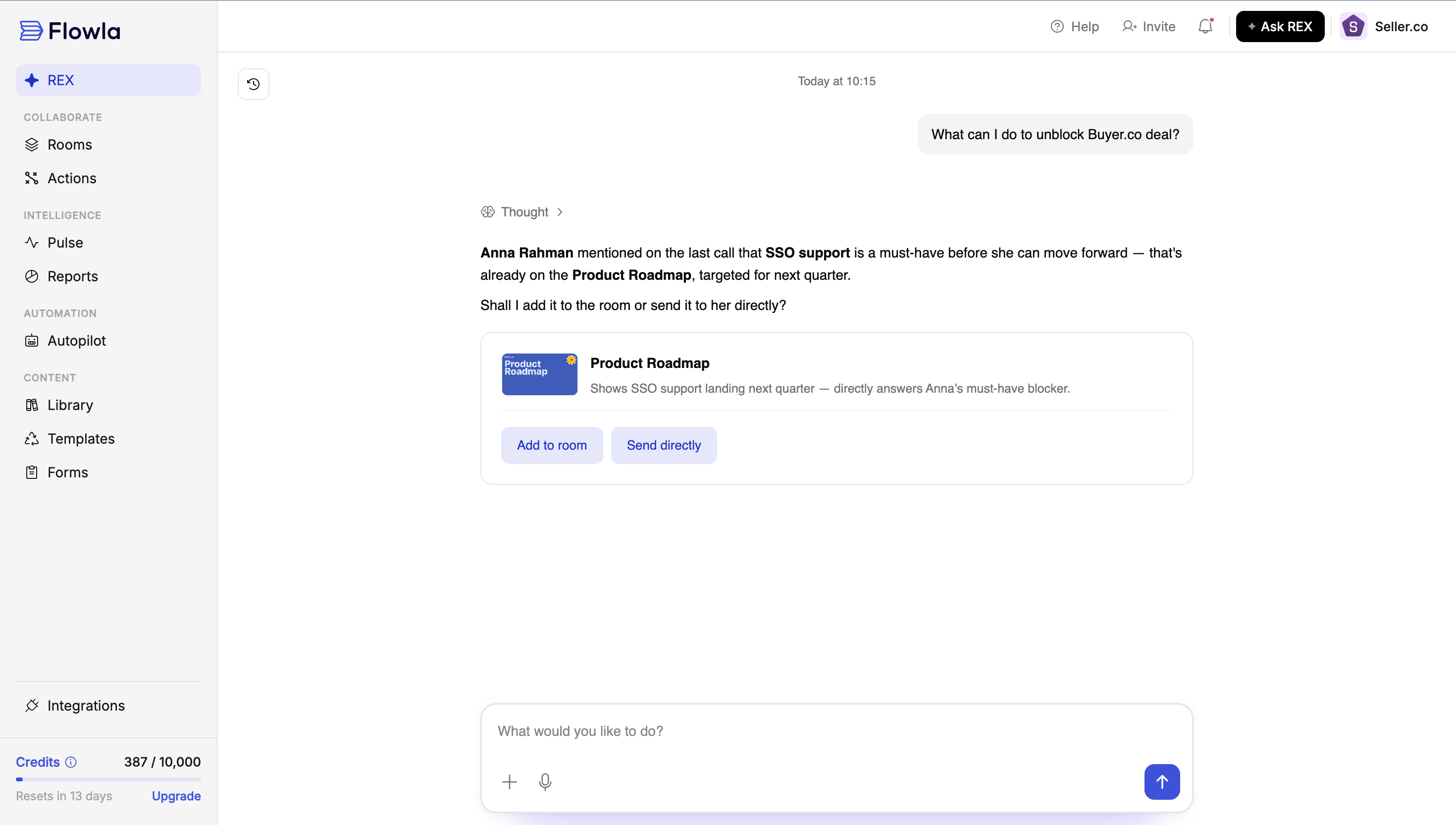
REX recommending a library asset, based on its extracted intelligence rather than its filename
How signals use it
REX has access to your library while it’s generating signals, so a recommended action can be genuinely concrete rather than generic advice. It can surface a specific case study or security one-pager that fits the persona and stage a signal is about, and prepare a share link for it, rather than just telling you to “share relevant content.” The asset a signal points to isn’t a hardcoded link. REX finds it at the moment the signal is generated, the same way it would if you’d asked directly in chat.Credit cost
Generating asset intelligence spends credits. The Library settings toggle says so explicitly: “Spends credits based on the asset type and size.”
In short, bigger or longer assets cost more to analyse, mainly because of the parsing step, while the graph-building step itself is a fixed add-on.
If your org doesn’t have enough credit balance to cover generation, it’s skipped rather than run partway.
How different roles use this
Sales reps
Sales reps
- Turn on Auto-generate asset intelligence in Library settings so new uploads are searchable and recommendable right away, without a manual step per file.
- If you upload something you need REX to use immediately, click Generate asset intelligence on that asset directly. This is useful before the auto-generation queue gets to it, or if the org toggle is off.
- Check an asset’s freshness before sending it to a prospect. An “outdated” or “stale” label is worth a second look, especially for anything with pricing, product screenshots, or competitive claims.
- Ask REX by meaning, not just by filename. “Find something for a healthcare buyer at the security-review stage” will work if the right asset has been analysed.
Onboarding & CS teams
Onboarding & CS teams
Your library isn’t just sales collateral. Onboarding guides, how-to docs, training decks, and support material benefit from the same intelligence.
- Generate (or auto-generate) intelligence on onboarding and training content so REX can recommend the right how-to doc or walkthrough by persona and use case, not just by filename.
- Check freshness before pointing a customer to a setup guide or training deck. Product changes fast enough that an “outdated” label on an onboarding asset is worth acting on quickly.
- If REX isn’t surfacing a training asset you know exists, check whether intelligence has actually been generated for it. An asset with no intelligence is invisible to search and to signal recommendations, even in an onboarding room.
Managers
Managers
- A pattern of signals recommending the same stale or outdated asset is worth flagging to whoever owns the library. It usually means a refresh is overdue, not that REX picked wrong.
- If reps report REX “can’t find” an asset they know exists, the likely cause is that intelligence was never generated for it. Check whether auto-generation is on for the org, or whether it needs a manual Generate asset intelligence click.
- Freshness scoring gives you a deterministic way to audit content hygiene across a library that’s grown over years, without relying on someone remembering which decks are outdated.
FAQ
Does generating asset intelligence cost credits?
Does generating asset intelligence cost credits?
Yes. Parsing costs 1 credit per page (or per minute for audio and video), plus a flat additional cost to build the intelligence graph itself. Bigger or longer assets cost more, mainly due to parsing.
What happens if I regenerate intelligence on an asset that's already been analysed?
What happens if I regenerate intelligence on an asset that's already been analysed?
The previous analysis is fully replaced, not merged. Every regeneration starts from scratch.
Is freshness an AI judgment?
Is freshness an AI judgment?
No. It’s calculated directly from the asset’s last-updated date, not generated by the model. The model is explicitly not allowed to override it.
Why can't REX find an asset I know is in the library?
Why can't REX find an asset I know is in the library?
Most likely, intelligence hasn’t been generated for it yet. Check that auto-generate is on, or generate it manually from the asset’s details.
Does asset intelligence update automatically if I edit the file?
Does asset intelligence update automatically if I edit the file?
Generation triggers automatically on new uploads. If you’ve replaced or edited an existing asset’s file, use Regenerate asset intelligence on it directly to be sure it reflects the update.
Can I see why REX described an asset a certain way?
Can I see why REX described an asset a certain way?
Yes. Every extracted field, including personas, stages, and competitors, carries evidence tying it back to the specific content that produced it.